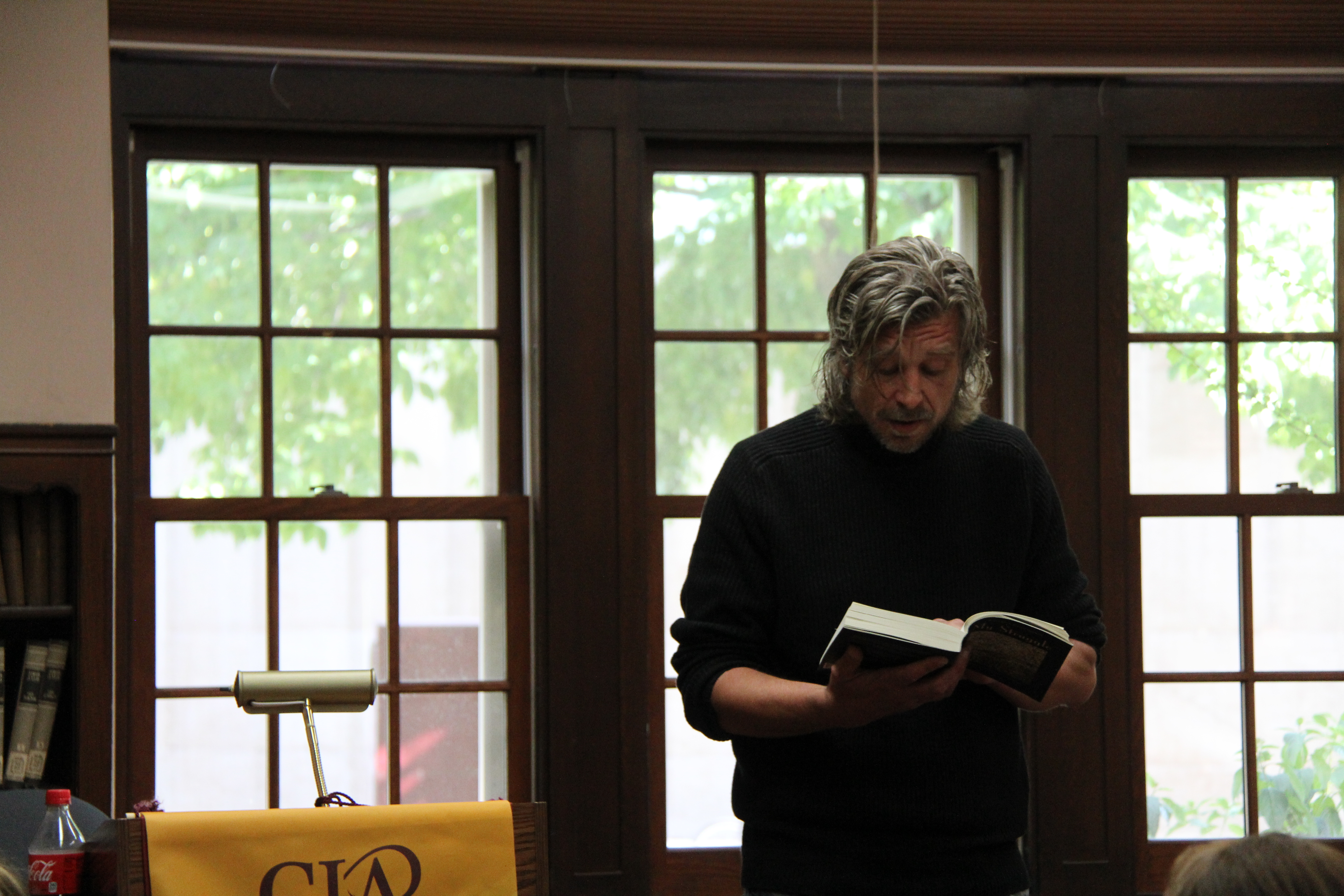
Karl Ove Knausgaard read from his controversial work Min Kamp 1 (My Struggle-First Book) on Tuesday, September 18, 2012 at the University of Minnesota. The recording of this event is now available on the European Studies Consortium's new YouTube channel. You can see the video by clicking here.
Tuesday, November 27, 2012
Award-Winning, Critically Acclaimed, Norwegian Novelist Karl Ove Knausgaard's Talk now Available
Karl Ove Knausgaard read from his controversial work Min Kamp 1 (My Struggle-First Book) on Tuesday, September 18, 2012 at the University of Minnesota. The recording of this event is now available on the European Studies Consortium's new YouTube channel. You can see the video by clicking here.
Labels:
"Karl Ove Knausgaard",
"Min Kamp 1",
Home,
YouTube
Full Scholarships Available for Intensive Language Study at the Middlebury Summer Language Schools
Middlebury Summer Language Schools announces the continuation of the Kathryn Davis Fellowships for Peace. The fellowship will cover the full cost of one summer of language study (tuition, room, and board)--from the beginner to graduate level--in any of six languages, including Russian. The postmark deadline is January 14, 2013. See the website for application details.
Need-based Financial Aid Available to All Students - Nearly half of 2012 Language Schools students received financial aid. Learn more about financial aid and other scholarships and fellowships.
Labels:
Fellowships,
Home,
Languages
Thursday, November 1, 2012
Alejandro Baer to speak about Kristallnacht in Civil War Spain
Kristallnacht in Civil War Spain
Tuesday, November 13
Room 1210 Heller Hall
4:00 p.m.
"Germany introduces forceful measures against the Hebrews.
A clear warning to international Jewry never again to make attempts on the lives of Germans." - Ideal, Granada, November 13, 1938.
Professor Baer will talk about the contrasting treatment given to the news of the German anti-Jewish pogroms on November 9 & 10, 1938 by the Francoist and Republican sides during the Spanish Civil War.
The Francoist press met the news with approval and glee, in contrast to the condemnations expressed in the Republican papers, which offered solidarity and support to the victims, even as the legitimate Spanish government approached it's own death agony.
The Spanish republicans soon recognized that their fate was intertwined with that of European Jews.
Professor Baer is the new director and Stephen C. Feinstein Chair of the Center for Holocaust and Genocide Studies. He is a distinguished scholar of Holocaust memory and testimony, and comes to Minnesota after serving on the sociology faculty of the Ludwig Maximilians-Universität-München in Germany.
His books include Holocausto. Recuerdo y representación (Holocaust: Remembrance and Representation) and El testimonio audiovisual. Imagen y memoria del Holocausto (Audiovisual Testimony. Image and Memory of the Holocaust). In addition he has authored numerous articles addressing issues of genocide, memory, and Anti-Semitism. He is currently engaged in research focusing on the uses and abuses of Holocaust history and memory in the Spanish-speaking world as well as the trans-nationalization of memory.
Sponsored by: Center for Holocaust & Genocide Studies,Department of History, European Studies Consortium, Institute for Global Studies and the Department of Spanish & Portuguese.
Tuesday, November 13
Room 1210 Heller Hall
4:00 p.m.
"Germany introduces forceful measures against the Hebrews.
A clear warning to international Jewry never again to make attempts on the lives of Germans." - Ideal, Granada, November 13, 1938.
The Francoist press met the news with approval and glee, in contrast to the condemnations expressed in the Republican papers, which offered solidarity and support to the victims, even as the legitimate Spanish government approached it's own death agony.
The Spanish republicans soon recognized that their fate was intertwined with that of European Jews.
Professor Baer is the new director and Stephen C. Feinstein Chair of the Center for Holocaust and Genocide Studies. He is a distinguished scholar of Holocaust memory and testimony, and comes to Minnesota after serving on the sociology faculty of the Ludwig Maximilians-Universität-München in Germany.
His books include Holocausto. Recuerdo y representación (Holocaust: Remembrance and Representation) and El testimonio audiovisual. Imagen y memoria del Holocausto (Audiovisual Testimony. Image and Memory of the Holocaust). In addition he has authored numerous articles addressing issues of genocide, memory, and Anti-Semitism. He is currently engaged in research focusing on the uses and abuses of Holocaust history and memory in the Spanish-speaking world as well as the trans-nationalization of memory.
Sponsored by: Center for Holocaust & Genocide Studies,Department of History, European Studies Consortium, Institute for Global Studies and the Department of Spanish & Portuguese.
Labels:
"Civil War",
Holocaust,
Home,
Kristallnacht,
Spain
Special Film Screening Demande à ton Ombre (Ask Your Shadow)
Special Film Screening
Demande à ton Ombre
(Ask Your Shadow)
with film director Lamine Ammar-Khodja
Wednesday, November 7
4:30 p.m.
St. Anthony Main Theatre
115 SE Main Street, Minneapolis
Tickets available by visiting: www.mspfilmsociety.org
Eight years after leaving native Algeria for France, Lamine Ammar-Khodja decides to end his exile on January 6, 2011, the day major riots break out in Algiers. Organized chronologically, the film is a first-person narrative dealing with the difficulties of getting back home. Because this journey isn't only a private matter, but also an opportunity to go back over Algeria's recent history, at a time when it could have taken another major turn.
Film discussion with director Lamine Ammar-Khodja and professor Patricia Lorcin, Department of History, University of Minnesota will follow the screening.
Demande à ton Ombre
(Ask Your Shadow)
with film director Lamine Ammar-Khodja
Wednesday, November 7
4:30 p.m.
St. Anthony Main Theatre
115 SE Main Street, Minneapolis
Tickets available by visiting: www.mspfilmsociety.org
Eight years after leaving native Algeria for France, Lamine Ammar-Khodja decides to end his exile on January 6, 2011, the day major riots break out in Algiers. Organized chronologically, the film is a first-person narrative dealing with the difficulties of getting back home. Because this journey isn't only a private matter, but also an opportunity to go back over Algeria's recent history, at a time when it could have taken another major turn.
Film discussion with director Lamine Ammar-Khodja and professor Patricia Lorcin, Department of History, University of Minnesota will follow the screening.
Labels:
"Lamine Ammar-Khodja",
Algiers,
Film,
France,
Home
Friday, October 19, 2012
"Los hombres que dispararon en los quioscos: los autores de la novela popular en España"
A talk, in Spanish, by Javier Pérez Andújar, Spanish author and critic
COME LEARN ABOUT SPANISH PULP FICTION!
Thursday, October 25, 2012
1:30 - 3:00 p.m.
116 Folwell Hall
In this talk, Javier Pérez Andújar will explain the history and development of one of the main literary expressions of mass culture in contemporary Spain: the "novela de quiosco" (similar to so-called "pulp fiction" in English).
Pérez Andújar will trace the relations of this kind of literature to broader cultural and social trends, highlighting the differences among its many sub-genres (such as westerns, war tales, science fiction, thrillers, and sentimental fiction), and their different ways of engaging with changing socio-historical realities over time.
Javier Pérez Andújar (Sant Adrià de Besòs, 1965) is the author of the novels Los principes valientes (2007), Todo lo que se llevó el diablo (2010) and Paseos con mi madre (2011). He has also written the non-fiction works Catalanes todos; las 15 visitas de Franco a Cataluña (2002) and Salvador Dalí: A la conquista de lo irracional (2003) and edited the anthologies of fantastic short stories Vosotros los que leéis aún estáis entre los vivos (2005) and La vida no vale nada (2008). He currently writes literary articles and short stories for the Catalan edition of El País and contributes toL'hora del lector, a Catalan television literary program.
Free and open to the public -- Light refreshments served
Sponsored by: Department of Spanish and Portuguese Studies, Global Programs and Strategy Alliance, and European Studies Consortium.
COME LEARN ABOUT SPANISH PULP FICTION!
Thursday, October 25, 2012
1:30 - 3:00 p.m.
116 Folwell Hall
Pérez Andújar will trace the relations of this kind of literature to broader cultural and social trends, highlighting the differences among its many sub-genres (such as westerns, war tales, science fiction, thrillers, and sentimental fiction), and their different ways of engaging with changing socio-historical realities over time.
Javier Pérez Andújar (Sant Adrià de Besòs, 1965) is the author of the novels Los principes valientes (2007), Todo lo que se llevó el diablo (2010) and Paseos con mi madre (2011). He has also written the non-fiction works Catalanes todos; las 15 visitas de Franco a Cataluña (2002) and Salvador Dalí: A la conquista de lo irracional (2003) and edited the anthologies of fantastic short stories Vosotros los que leéis aún estáis entre los vivos (2005) and La vida no vale nada (2008). He currently writes literary articles and short stories for the Catalan edition of El País and contributes toL'hora del lector, a Catalan television literary program.
Free and open to the public -- Light refreshments served
Sponsored by: Department of Spanish and Portuguese Studies, Global Programs and Strategy Alliance, and European Studies Consortium.
Labels:
"Pulp Fiction",
Home,
Literature,
Spain
Friday, October 5, 2012
The Czech Republic: Still in Transition? The difficult voyage from Communism to European Union - to today
Wednesday, October 17, 2012
12:00 p.m.
1210 Heller Hall
Twenty-two years ago Czechoslovakia launched itself on a journey towards a free and democratic society. Under the motto Back to Europe, people expressed their desire to recapture the interrupted tradition of excellence, openness and toleration that characterized the first Czechoslovak Republic of 1918-1938.
Led by the visionary President, Václav Havel, the Czech Republic has reached important milestones, joining NATO and the EU. The largely successful transformation can be used as a model for the closed societies such as Cuba and Iran, or the ones in early transition, such as the Arabic countries in the aftermath of the Arab revolutions. In general, the experience of Central Europe, with its successes and failures, is a useful, albeit limited tool in all attempts to calibrate transition from a close to an open society.
Dr. Klvana's career spans from being the student leader during the velvet revolution that toppled the Communist Government, to being an important journalist, public official, and now major proponent of non-profit civil society. His work with the Zdenek Bakala Global Non-Profit Programs oversees several projects, including the Vaclav Havel Presidential Library and the newly established branch of the Aspen Institute on whose Board of Directors he serves as Vice President.
He is lecturer at the New York University in Prague. He worked as press secretary and policy adviser to President of the Czech Republic, Vaclav Klaus, and in 2007-08 was a special Government Communication Envoy for the Missile Defense Program. In 2001-03 Dr. Klvana was Deputy Editor-in-chief of Hospodarske Noviny (a leading Czech daily) and in 2000-01 a senior international commentator for the Czech daily newspaper Mlada Fronta Dnes. In 2011 Dr. Klvana published his literary debut, a novel "Marina, A Russian Story" in Czech by Paseka Press. Dr. Klvana serves on the Board of Directors of Economia Publishing, a leading Czech media organization, and also on Board of ther Harvard Club in Prague, and is a member of the Czech Euroatlantic Council.
In 2012 he was awarded the prestigious Distinguished Leadership Award for Internationals from the University of Minnesota, where he earned his PhD degree in Speech Communication 1997. He also holds an MA degree in journalism from the Charles University in Prague. In 2003 he was a Shorenstein Fellow at Harvard University Kennedy School. Dr. Klvana publishes a blog in Czech in which he analyses international relations for leading Czech media. He frequently participates in international conferences.
Sponsored by: Global Studies, Austrian Studies, European Studies Consortium, History, Global Programs and Strategy Alliance.
For more information contact Katie Evans.
12:00 p.m.
1210 Heller Hall
Led by the visionary President, Václav Havel, the Czech Republic has reached important milestones, joining NATO and the EU. The largely successful transformation can be used as a model for the closed societies such as Cuba and Iran, or the ones in early transition, such as the Arabic countries in the aftermath of the Arab revolutions. In general, the experience of Central Europe, with its successes and failures, is a useful, albeit limited tool in all attempts to calibrate transition from a close to an open society.
Dr. Klvana's career spans from being the student leader during the velvet revolution that toppled the Communist Government, to being an important journalist, public official, and now major proponent of non-profit civil society. His work with the Zdenek Bakala Global Non-Profit Programs oversees several projects, including the Vaclav Havel Presidential Library and the newly established branch of the Aspen Institute on whose Board of Directors he serves as Vice President.
He is lecturer at the New York University in Prague. He worked as press secretary and policy adviser to President of the Czech Republic, Vaclav Klaus, and in 2007-08 was a special Government Communication Envoy for the Missile Defense Program. In 2001-03 Dr. Klvana was Deputy Editor-in-chief of Hospodarske Noviny (a leading Czech daily) and in 2000-01 a senior international commentator for the Czech daily newspaper Mlada Fronta Dnes. In 2011 Dr. Klvana published his literary debut, a novel "Marina, A Russian Story" in Czech by Paseka Press. Dr. Klvana serves on the Board of Directors of Economia Publishing, a leading Czech media organization, and also on Board of ther Harvard Club in Prague, and is a member of the Czech Euroatlantic Council.
In 2012 he was awarded the prestigious Distinguished Leadership Award for Internationals from the University of Minnesota, where he earned his PhD degree in Speech Communication 1997. He also holds an MA degree in journalism from the Charles University in Prague. In 2003 he was a Shorenstein Fellow at Harvard University Kennedy School. Dr. Klvana publishes a blog in Czech in which he analyses international relations for leading Czech media. He frequently participates in international conferences.
Sponsored by: Global Studies, Austrian Studies, European Studies Consortium, History, Global Programs and Strategy Alliance.
For more information contact Katie Evans.
Labels:
"Czech Republic",
"European Union",
Home,
Klvana
Wednesday, September 19, 2012
20th International Conference of Europeanists Submission Portal is Now Open
The submission portal for The 2013 Conference is now open! Submit your paper, session, or mini-symposium proposal today. The Council seeks proposals on all aspects of European history, society and politics, and particularly welcomes those that transcend disciplines, nationalities, and generations.
Submission deadline: October 8, 2012
Propose a symposium! Did you know that CES accepts proposals for 2-4 linked conference sessions on a common theme? Called a "mini-symposium," these linked sessions provide the opportunity to examine an issue in greater depth, are specially featured in the conference program, and are strongly favored by the Program Committee.
For more information visit the Council for European Studies at Columbia University's web site.
Submission deadline: October 8, 2012
Propose a symposium! Did you know that CES accepts proposals for 2-4 linked conference sessions on a common theme? Called a "mini-symposium," these linked sessions provide the opportunity to examine an issue in greater depth, are specially featured in the conference program, and are strongly favored by the Program Committee.
For more information visit the Council for European Studies at Columbia University's web site.
Labels:
"European Studies",
Conference,
Home,
Papers,
Symposia
Subscribe to:
Posts (Atom)
© Regents of the University of Minnesota. All rights reserved. Equal opportunity educator and employer.