Go to the U of M home page

Pages

Showing posts with label Holocaust. Show all posts

Thursday, April 3, 2014

Twin Cities Film Premier Aftermath & The Last of the Unjust

Aftermath
Thursday, April 10
7:00p.m.
St, Anthony Main Theatre
Part of The Film Society of Mpls/St. Paul International Film Festival
Introduction by Alejandro Baer, Director CHGS

For tickets and information please click here.

Inspired by real events that haunt Poland's past, Wladyslaw Pasikowski (who wrote the screenplay for Andrzej Wajda's Katyn) turns in a hard-hitting allegory on the anti-Semitism that still raises its ugly head in his home country. Franek and Jozek are brothers who are reunited after 20 years in order to take care of the family farm. Franek, recently returned from the US, discovers that Jozek has been ostracized from the community for threatening to uncover a dark secret. As Franek and Jozek struggle to rebuild their relationship, they are drawn into a horrifying gothic tale. Upon its release in Poland, Aftermath received acclaim, but also generated intense controversy.
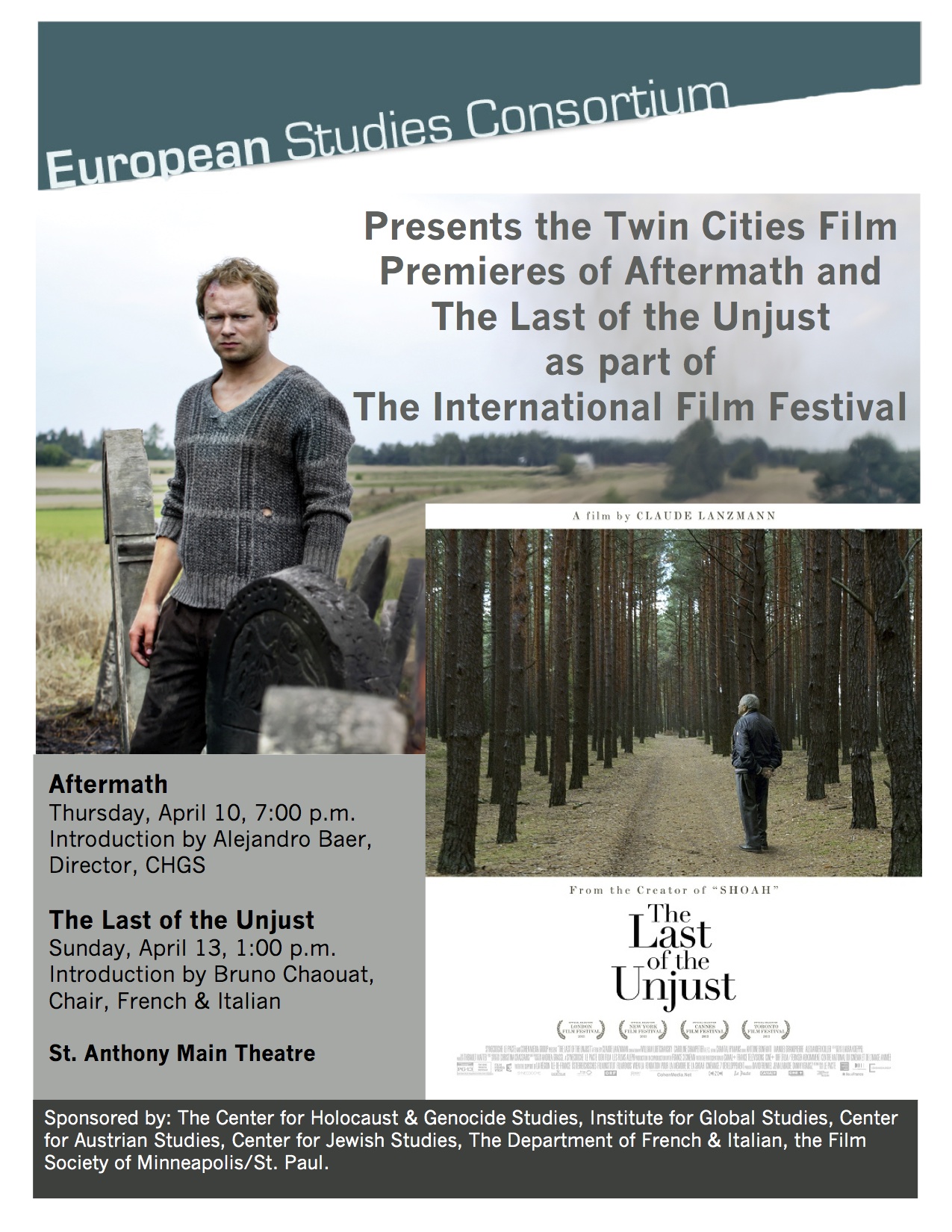
CHGSmovie2014.jpg

The Last of the Unjust
Sunday, April 13
1 p.m.
St Anthony Main Theatre
Part of The Film Society of Mpls/St. Paul International Film Festival
Introduction by Bruno Chaoaut, Chair, Department of French & Italian, former director CHGS.

For tickets and information please click here.

Claude Lanzmann returns to a series of interviews he made in 1975 with Benjamin Murmelstein, the last President of the Jewish Council in the Theresienstadt ghetto. Murmelstein was largely demonized after the war, accused of collaborating with the Nazis, with his survival being the proof. These interviews, however, tell a different story--one of a pragmatic man who fought not only for his own survival but also the survival of every Jew he could possibly help. A powerful addendum to Lanzmann's masterpiece Shoah, The Last of the Unjust employs an unadorned style for an incredibly complicated historical narrative that continues to be defined today.
Sponsored by the European Studies Consortium, Institute for Global Studies, Center for Austrian Studies, The Center for Jewish Studies, the Department of French & Italian, and The Film Society of Mpls/St. Paul.

Thursday, November 1, 2012

Alejandro Baer to speak about Kristallnacht in Civil War Spain

Kristallnacht in Civil War Spain
Tuesday, November 13
Room 1210 Heller Hall
4:00 p.m.

"Germany introduces forceful measures against the Hebrews.
A clear warning to international Jewry never again to make attempts on the lives of Germans."
- Ideal, Granada, November 13, 1938.

Thumbnail image for 3Robert-Capa-Alarma-antiaerea-en-las-calles-de-Bilbao-Guerra-civil-Espanola.jpgProfessor Baer will talk about the contrasting treatment given to the news of the German anti-Jewish pogroms on November 9 & 10, 1938 by the Francoist and Republican sides during the Spanish Civil War.

The Francoist press met the news with approval and glee, in contrast to the condemnations expressed in the Republican papers, which offered solidarity and support to the victims, even as the legitimate Spanish government approached it's own death agony.

The Spanish republicans soon recognized that their fate was intertwined with that of European Jews.

Professor Baer is the new director and Stephen C. Feinstein Chair of the Center for Holocaust and Genocide Studies. He is a distinguished scholar of Holocaust memory and testimony, and comes to Minnesota after serving on the sociology faculty of the Ludwig Maximilians-Universität-München in Germany.

His books include Holocausto. Recuerdo y representación (Holocaust: Remembrance and Representation) and El testimonio audiovisual. Imagen y memoria del Holocausto (Audiovisual Testimony. Image and Memory of the Holocaust). In addition he has authored numerous articles addressing issues of genocide, memory, and Anti-Semitism. He is currently engaged in research focusing on the uses and abuses of Holocaust history and memory in the Spanish-speaking world as well as the trans-nationalization of memory.

Sponsored by: Center for Holocaust & Genocide Studies,Department of History, European Studies Consortium, Institute for Global Studies and the Department of Spanish & Portuguese.